
It is always worth trying.
Today is a blessed celebratory day in the Banks household.

Because today is the day I have finally crossed the elusive threshold of 100 paid subscribers and so earned an orange check next to my name.
Note: I’m exactly on that threshold, and three of the people are free trials, so ironically enough I could still lose this check. If you would like to help protect me from this dire fate you can subscribe here:
For those unfamiliar: Substack’s checks work a little like the old pre-Elon Twitter system, except nobody at the company decides whether you’re famous enough to deserve one. They’re earned entirely through the paid subscription model — the tiers run from hundreds of paid subscribers up through tens of thousands. It is, I think, a pretty fair system. A paid subscriber is somebody who buys into the thing you’re doing enough to give you money and collecting 100 of them is no mean feat.
To me this represents something significant. Namely, the crossing of a threshold I have sought, and climbed, and crawled towards for the last three odd years. It might seem silly to someone else, and I’ll admit that what I earn here isn’t going to buy me a house in Malibu — I gave out discounts, and between those and the annual subscriptions it works out closer to $300 a month than $500. But it’s a non-trivial amount of money and the idea that 100 people are willing to give me some of their own money just to read about my nerdy thoughts on the Office, or WW1, or my favorite philosophers, is… well, it is indescribable.
So today I wanted to write a little bit of an autobiography of the history of my blogging, and put forward a core thesis of mine: it is always worth trying.
The autobiography
I began “blogging” for the first time with two of my friends back in the closing months of 2023. At the time we were publishing on a website one of them had built for us — Voyager’s Log. I literally didn’t know Substack was a thing, and our mailing list was composed exclusively of friends and family.
My first article, which we have since republished on Substack here, was a blast to write, and from that moment I was hooked. Of course, since we were just putting it on our website, I immediately began trying to push my content on everyone I could find. Posting it on LinkedIn, sharing it with people I knew, talking about it with strangers, posting on Reddit, and otherwise being a huge pain in the ass. But I loved it. I loved writing about my ideas, and I loved even more getting to talk to people about it. I’ve always been an idea guy but, as my Substack publication’s title would suggest, I’m not someone who sticks to my ideas for long. This meant I was leaving a field of half-digested impulses behind me, and writing was an opportunity to sit down and actually finish them.
For the next five or so months we published only on our own website, until I one day stumbled onto Substack and realized it might offer us a suggestion algorithm to actually ride. Previously I had been trying to either post AI readings of the essays on YouTube or post links to them on Reddit, but neither had produced much success. On YouTube the problem was no one wanted to listen to random essays read by an AI, and on Reddit I was constantly having my posts removed. When they weren’t removed, the engagement was, well, it was full of redditors.
From about May through October 31st we got functionally no engagement. One article I wrote got maybe 8 likes, but that was after ruthlessly spamming it everywhere I could, and we had developed an audience of ~maybe~ 5 real people. Then I wrote an article about the polls around the upcoming election and it “took off” — for me. The article ~2k views and ~20-odd likes, and for the first time there were people actually “reading” my stuff. It was at this same point I discovered Notes and began to spam like 25–50 posts a day. I had never gotten ~any~ interaction on X or anywhere, and so this was intoxicating beyond belief. And then the ball began to roll more quickly. After the election, on November 10th, I wrote what is still one of my favorite pieces — “To Govern, Govern Well” — and it actually hit the algorithm.
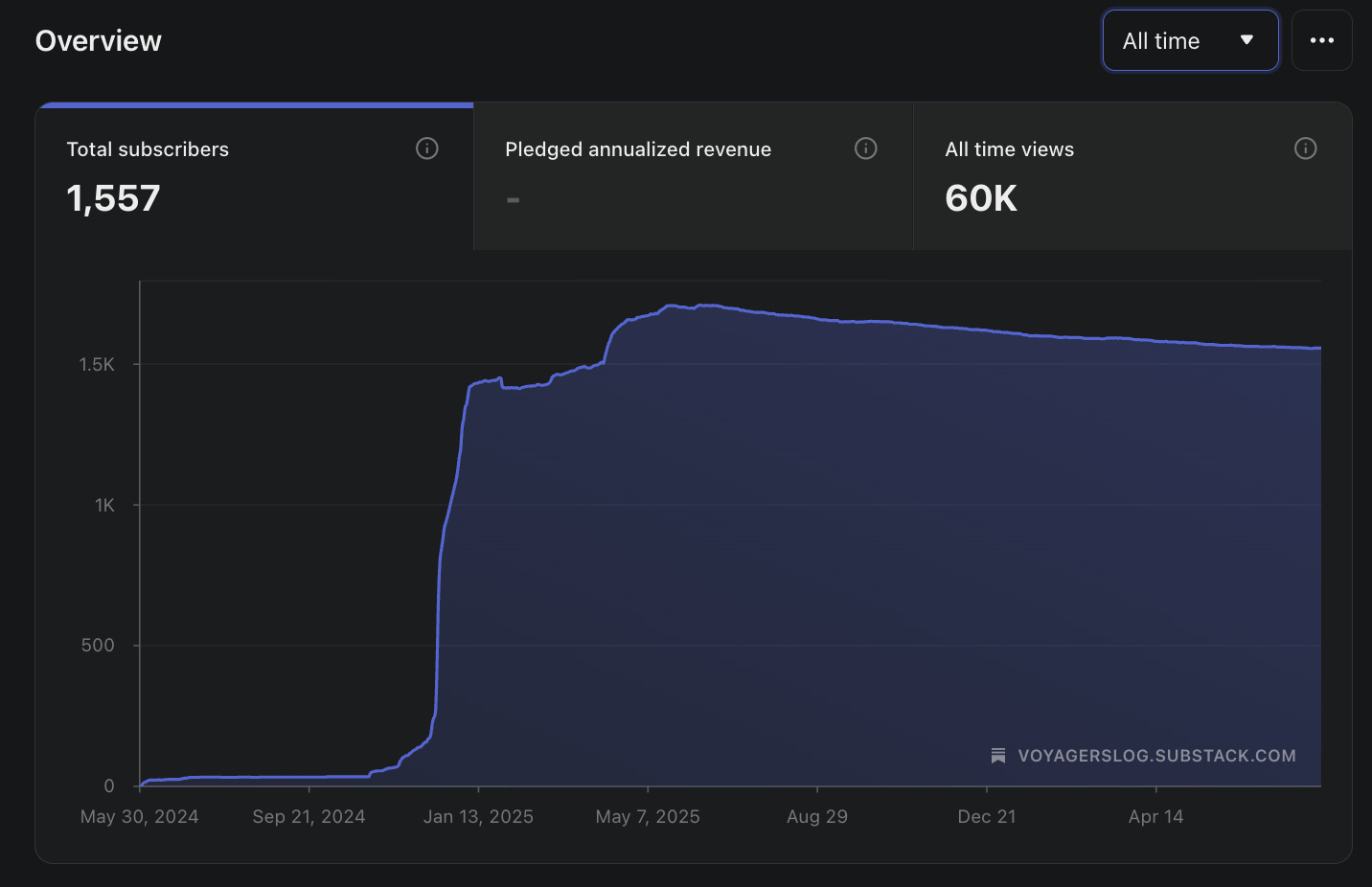
At that point “Peter Banks” began to pick up weight on Notes, and the week or so around the end of 2024 was ridiculous by any measure. On one of the days I gained over 160 subscribers, and since at the time I had it set to email me every time I got a new sub, my phone was exploding.
In that moment I benefited from the same gift everyone just starting out has. No one had any idea who I was. This meant I could be everything to everyone. To liberals I could be a frustrated former Democrat — not necessarily untrue. To chuds I could be a fellow traveler — again, there is an honest spin to this. Naturally, as I grew, my flavor became more clear and I was funneled to the subset of this platform where I naturally belong.
That winter was simultaneously one of the greatest winters of my life, and one of the most frustrating, darkest ones. Because what ended up killing the run was that I had to go to a tax conference in North Carolina. And “conference” is somewhat underselling it — it was more like a private symposium, a small number of invited students learning about corporate tax research. It was a week long, and I obviously wasn’t going to be able to post on Notes at all. At the time Substack didn’t have the ability to schedule posts. So I was going to essentially just disappear. And it’s pretty funny, because you can see on the graph that this is exactly when the growth stops. Maybe it kept going for a day or two afterwards, but it was while I was at that symposium that the rate of growth simply stopped.
And at this same symposium I happened to catch some illness — I felt like dog shit and had to leave early and go home. I remember very distinctly sitting in the Raleigh–Durham airport in the middle of January, hours early because I had nowhere else to wait, playing a Hearts of Iron IV mod called The New Order, and being furious that I had lost this momentum. It was one of the most frustrating and darkest stretches I can remember. I came back and started posting again. And never again was I able to quite catch fire the way I did in those early months.
But what I was able to do was actually develop an audience. And it was at that point that I finally began to write for other people. Previously, the writing was basically for myself — I mean this literally, because no one was reading it. The true audience of any article was me. I wanted to take the time to carefully think through the ideas I had bouncing around inside my head. That changed substantially, and I began writing articles for other people.
There was another change, I realized I could make it as a writer. I didn’t know how long it would take. I didn’t know how many battles I would have to fight. But this was what I wanted to do, and it was possible — there was a combination of cards I could play that would lead to me earning a full-time income by writing, and I had an obligation to myself to try, to throw myself at it with reckless abandon.
In the year and a half since, a lot has changed in my life. I’m no longer a PhD student at Stanford. I am now the president of a small think tank — The Boyd Institute — and I’m expecting a child this November. Still I know when I look back on my life this whole period will be one blur to me.. The period where I began to build the life I sincerely wanted. A process I’m still in the middle of, and which I have no intention of slowing down.
This brings me to the other point I wanted to make. It is always worth trying.
On trying
Modernity — or at least my slice of it — emphasized thinking things through. There was an enormous indexing on being self-reflective and careful. On having a plan. And this is good; a bad plan is better than no plan. But one of the problems with it is that it can lead you to the false conclusion that everything has already been solved.
Consider: we did not put wheels on suitcases until the 1970s. This is such a blindingly obvious innovation — something that anyone with any amount of intelligence should have realized almost immediately. You have this hard-bodied object; you can just put some wheels on it, put it at an angle, and roll it. And yet no one thought of it.
The details make it worse. Bernard Sadow, a luggage executive, filed the patent in February 1970 — six months after we put a man on the moon — after watching an airport porter roll heavy machinery around on a wheeled pallet. Department stores turned him down for months; he was told, more or less, that men would never accept suitcases with wheels. And even his version wasn’t the answer: the upright roller bag with the telescoping handle — the one you actually own — wasn’t invented until 1987, by an airline pilot working in his garage.
It took somebody actually doing it. Somebody solving the problem, and not telling themselves the problem had already been handled — approaching the world with an open mind toward what could be improved.
We’ve all been inoculated by what I would describe as the efficient market hypothesis of society. The idea that there’s someone out there doing the thing better than you could do it at any given moment. And if it’s not that, then there’s some invisible other force that adjudicates who wins and who loses, and you are simply at the whims of it. I think this is patently false. There are circumstances where it borders on true — if you think there’s secret money to be made in the financial markets, I have a bridge to sell you. But very little of life is as efficiently pored over for arbitrage as the American capital markets. There are enormous, enormous fields of human affairs that lack the army of Chinese engineers trying to decode the smallest problems, and if you focus on one of these areas, it is very possible for you, as a Human, to still make a contribution.
I remember an interview of Dwarkesh Patel’s from a while back where the question came up: why start a podcast at all? Wasn’t that a saturated marketplace? And the answer was that once you actually get into something, you realize there are not that many people doing anything — not that many people really trying to do something at a high level. I think that’s extraordinarily true. The world is not composed of unlimited people of all types. There are always shortages. There are always things being done poorly. There are always problems that need to be solved.
And here is the heart of it: you don’t know ex ante. You can never know ex ante. Ex ante, you cannot know your type. You cannot know how difficult the thing actually is. You can never even really know what needs to be done. It’s only when you start to try — when you begin to execute — that you learn what the failure modes are, what actual success looks like, what the metrics worth tracking even are. You simply cannot replicate this by thinking. And if you’re sitting there telling yourself that you could do it better, you owe yourself an attempt. You owe yourself a shot at the board.
Now, the obvious objection: this is what winners say. “Always worth trying” is the motto of everyone it worked out for, and the people it didn’t work out for aren’t writing celebration posts.
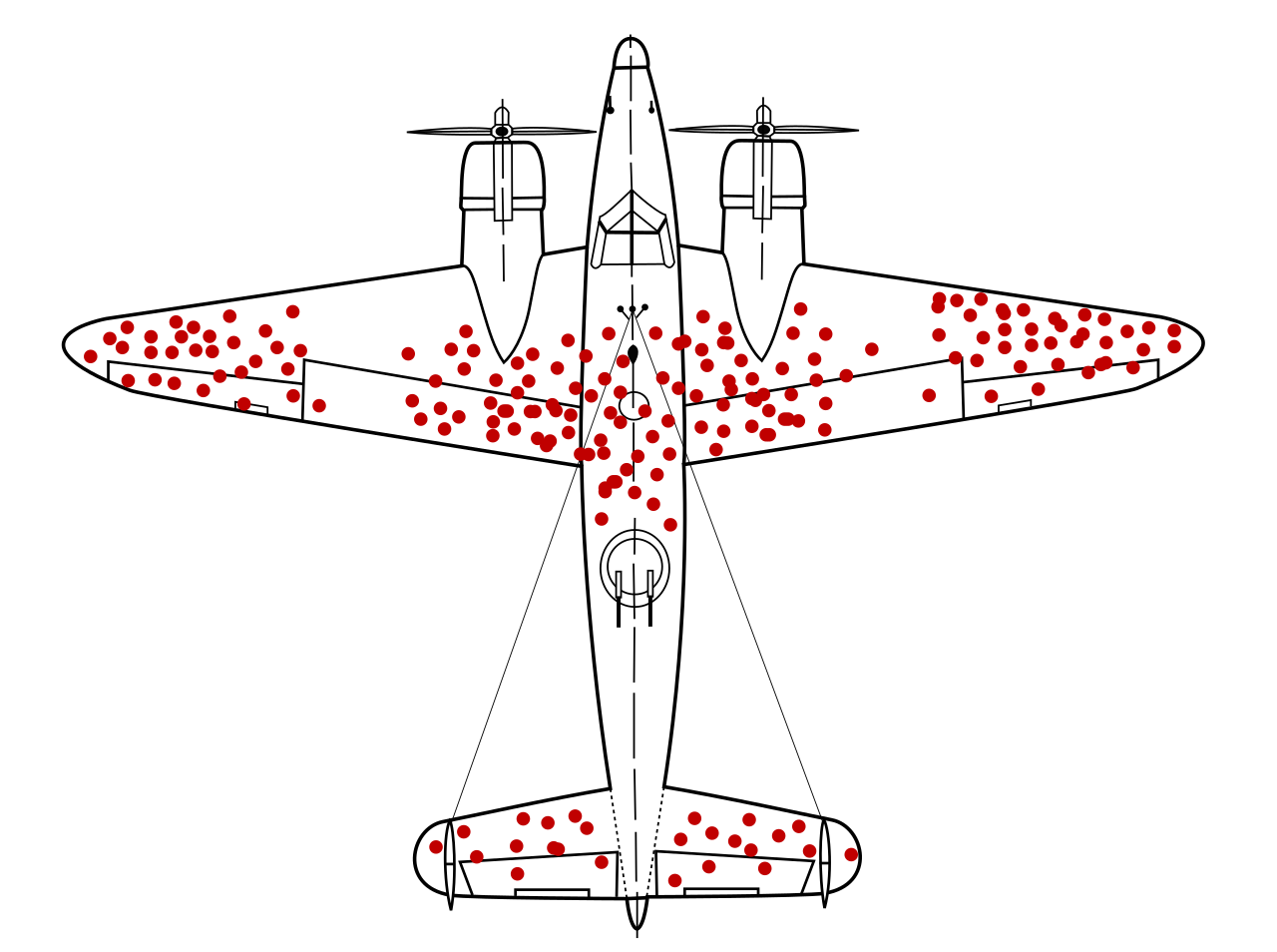
Fair. But the objection misunderstands what trying buys you. The return on an attempt isn’t victory but the knowledge about the possibility of the thing. If I hadn’t loved writing, what would a life of imagining I did actually buy me? By trying you can find out if that door budges or not.
So this is a little celebration on my part, and a little thank-you to everybody who made it possible — it literally would not have been possible without all of you. If you’re a paid subscriber, know that I look at your names not infrequently. There’s doubtless a degree of narcissism in all of this, and I want to acknowledge that. But there’s also something incredibly and substantively beautiful about getting to share your ideas with people who share them too. The idea that I can sit down and write an article about World War I and the Treaty of Versailles and the German Revolution, and that this can earn me money, is so absurd and so beautiful and so wonderful that it is impossible for me to fully get my mind around. This isn’t a kingly income. It’s the first hurdle in something I know I’ll spend the rest of my life building.
I don’t really know what else to say other than that.
It’s just worth trying.
I really enjoyed peering behind the curtain with this one. I’m trying to remember when I first encountered your work on Substack; it must have been late 2024/early 2025. Thanks for making Substack a more interesting and thoughtful place!
Also… I can’t believe you didn’t know about Substack in 2023!
I think I’m one of those free trials. Don’t worry I’m sticking around 🫡