Someone is deeply wrong about Iran right now
This is Trump's war either way

I have been, like many of you, following the US-Iran war extremely closely in recent days, and the main feeling that I cannot shake is that within the information environment I am exposed to there are a couple of competing narratives about what is going on that are fundamentally incompatible.
First, you have a number of large social media communities that have genuinely talked themselves into the belief that the US is facing an imminent military defeat.
Second is the Trump administration itself, which seems to be strongly of the opinion that not only has the military phase of this war functionally concluded but that it has concluded with a resounding US victory.
And finally, there is the media establishment, most of the people I’ve read here on Substack, and foreign policy experts who appear to believe that the US has blundered into a war with little strategic vision and that not only have we failed to actually militarily crush the Iranians but they continue to pose a significant threat to the oil market and US forces.
Now I want to be clear about my bias up front. I very much want the Trump administration narrative to be true because I want America to decisively win this war. I make no apology for that bias, and so I’m not going to try to hide it either. But this aside, I still think it is a worthwhile task to steelman, as much as I can, these different models of what is going on in an effort to approach the truth.
This is important because the models of reality they each present are fundamentally incompatible. Either 1) the US is tactically losing the war, or 2) we have just “concluded” a Desert Storm–level military success, or 3) we have set off a global catastrophe and Trump is about to back down in the face of resurgent Iranian might, allied and domestic pressure, and an oil shock. There is no way to know right now with certainty what will happen; only time will reveal that.
However the war resolves we should all remember that this was Trump’s war. He began it without the approval of congress and at no point was the genuine buy in of the American public sought. This means that we can look at it objectively. If this “little excursion” turns into a grand strategic success I will applaud it, if it turns into a quagmire or otherwise fails I will condemn it.
Dealing with each narrative in turn.
Narrative 1: The US is losing militarily
As I mentioned, there is a significant amount of chatter on social media to the effect that the US has not only strategically blundered into a war it cannot win but is actively tactically losing the fight right now. The specific way this is phrased can vary a lot between posters, and doubtless at least part of it is the result of foreign actors trying to stir the domestic pot, but I think the dynamic is consistent enough that I would feel irresponsible not at least touching on it.
You can see here a tweet by Max Blumenthal, the editor of “The Grayzone.”
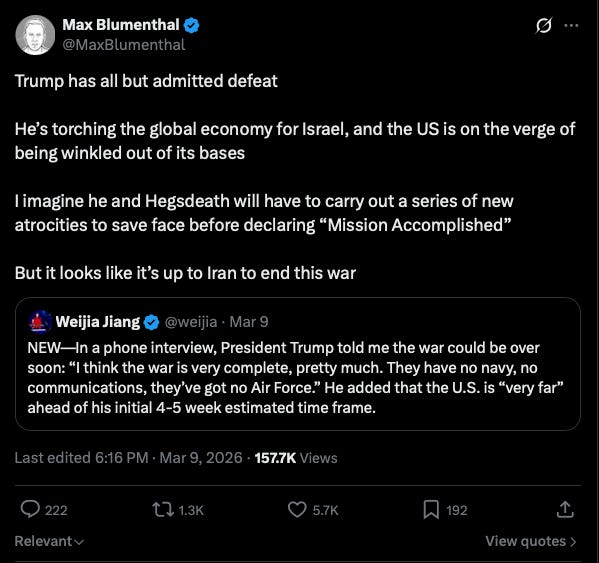
Or here you can see Hasan Piker, the largest leftist content creator, saying effectively the same thing.

Here is a video from Vaush, another large streamer.

It is functionally impossible to browse X without seeing posts like this with tens of thousands of likes in your feed.
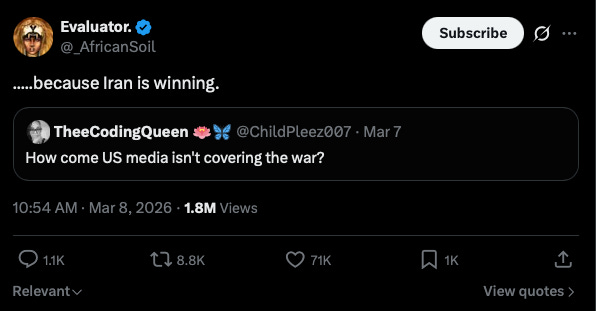
And the stuff I’ve seen on TikTok and Instagram about this war is so unhinged I don’t even know where to begin. Many people have convinced themselves that Tel Aviv is being actively destroyed and the US has been routed from the region already.
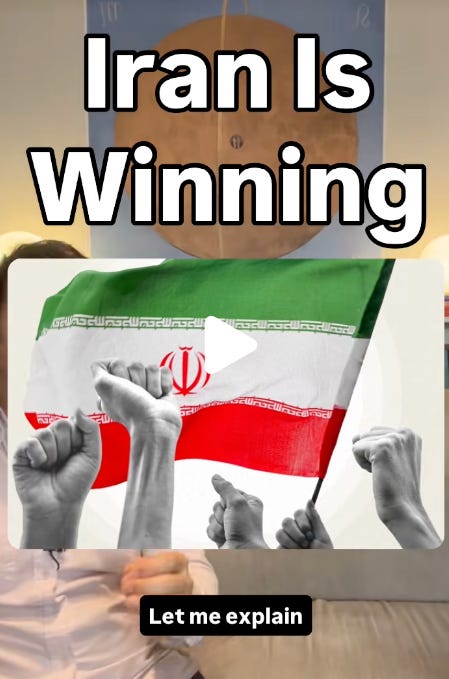
Now it is, candidly, very difficult for me to steelman this perspective because it is, in my opinion, completely detached from reality. But in a way that is sort of the point. Our media has become so poorly trusted by most people that a huge fraction of the public has functionally turned to social media as a path to “the truth.” Since there is very little cost to lying online, people forget things quickly, but there is an enormous upside to being “interesting.” The result is a gradual arms race of sensationalism which leads to the moment we are in. This has been compounded by the issue of AI videos, and in many real ways we have crossed an informational event horizon I see no way of getting back from. A huge fraction of the public is proudly misinformed at this moment, and there is basically nothing that can be done about it.
Narrative 2: Trump and Co.
If you listen to the press conferences from the US, as I have been, you would get the impression that what we and the Israelis have achieved in ten days is beyond anything in history. According to the administration, the Iranian military has been eliminated using advanced US technology with effectively zero losses. The Supreme Leader is dead and his replacement is at minimum wounded. Their air force and navy have been totally eliminated, and the rate of missile firing has fallen by 92%.
In short, the “war,” in the meaningful sense of an active conflict, is over, and what remains is a sustained degradation campaign that will last weeks or months and will end when the administration decides Iran has been sufficiently broken.
But don’t worry, this is not Iraq, they will say, because rather than trying to occupy the country we are implementing a new model of warfare where we will simply kill the enemy leadership class and military until nothing remains.
Take these quotes from Trump:
“We’re achieving major strides toward completing our military objective. And some people could say they’re pretty well complete.”
“We’ve wiped every single force in Iran out, very completely.”
“The big risk on that war has been over for three days. We wiped them out the first — in the first two days.”
Or Chairman of the Joint Chiefs of Staff Gen. Dan Caine, who stated that despite predicting more US losses, the operational picture was “decisively in our favor.” Many congressional Republicans, such as Lindsey Graham, are on the same page.
Finally, it seems from oil prices that the market is predicting that the hot phase of the war will be over in a matter of days and the strait will be open again soon. At the time of writing this, oil sits at about $92 a barrel, roughly 50% up from the pre-war price but nowhere near either the heights it reached this weekend or where analysts would have expected it to settle in a universe where the strait is impassable for months.
The core evidentiary pillars for this argument are something like the following.
Venezuela “proves” that this formula works.
After Delta Force operators, supported by the 160th Special Operations Aviation Regiment, captured Nicolás Maduro and his wife in a nighttime raid, VP Delcy Rodríguez was sworn in as interim president and immediately began cooperating with Washington as a de facto puppet.
Within months, according to Trump, over 100 million barrels of Venezuelan oil have flowed to Houston refineries and their legislature is busy changing the law to allow US oil companies to cash in. If you want to see how far this action was outside of the consensus it was possible, I suggest you play a hypothetical game with ChatGPT. Here is what it had to say to me when I tried.
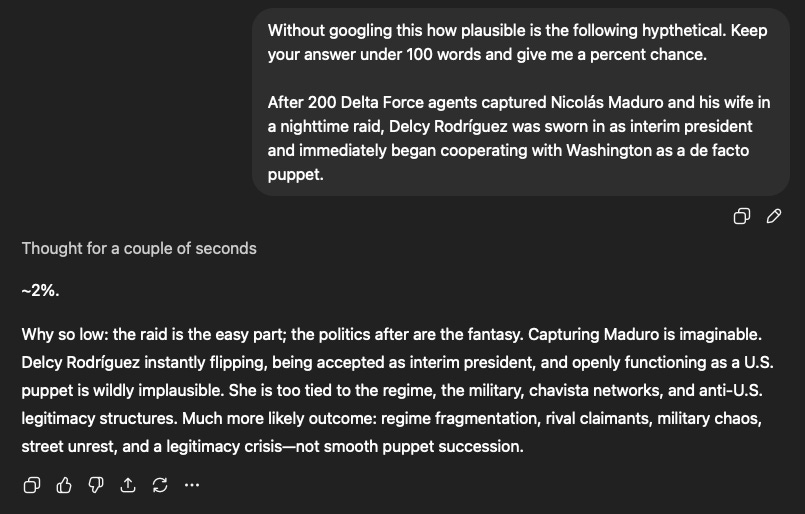
Trump and co. seem to be betting on a similar outcome here, and it is clear from all of their press conferences that the formal collapse of the regime isn’t even their preferred outcome. It is strongly in the interest of local Iranian elites to play ball here because Saudi Arabia shows America is more than willing to tolerate an Islamist autocracy as long as they don’t cause problems for us or try to antagonize Israel. If a conciliatory faction of the Iranian government is able to wrestle control of the state from the IRGC, then the entire elite class could become wealthy overnight.
Trump doesn’t always chicken out.
The TACO thesis became conventional wisdom among stock traders in 2025 after repeated tariff reversals. Basically, the argument went that Trump would talk a big game but anything which seriously threatened to cause economic damage to America was beyond him.
Clearly this belief was held in Iran as well, where according to sources familiar with the intelligence Khamenei believed “no one had the guts to strike him,” and yet on February 28 Khamenei and nearly 50 senior regime leaders were killed during a gathering at his compound in Tehran.
In his press conference on the 9th, Trump was clear that he thought this would push up oil prices, but he opted to pull the trigger anyway. It seems plausible, or at least the Trump administration would want you to believe it is likely, that he has no intention of stopping now.
Part of the reason that Trump seems so willing in this scenario to risk both his polling and a market crash is that it genuinely does appear to be the case that he feels personally wronged by Iran. From that same night:
“Hey, look, I had a target on my back because, as you people wrote pretty well, they caught the assassin that was after me. So we just got them first, but they caught the assassin.”
The military destruction is lopsided and very real.
Simply look at the numbers.
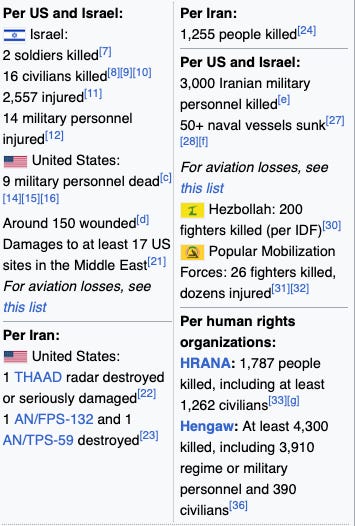
This would amount to functionally the entire Iranian navy and air force, along with a huge slice of their leadership class. In fact, the numbers obscure the scale of Iranian losses because what is not shown is damage to their launchers and military industrial complex, both of which have been extensive.
The whole region is turning on Iran.
While Iran did manage to inflict some damage on US forces — killing 9 Americans, wounding 150, and destroying roughly $2 billion in equipment including a $1.1 billion radar at Al Udeid — its ability to harm US assets was severely limited. As a result, they decided to effectively attack almost all of their neighbors. Largely the attacks have failed to deal significant damage, but what they have managed to accomplish is burning whatever bridges existed.
The evidence here is mixed and you should be honest with yourself about it, but right now it is unambiguous that the Gulf states that are operationally aligned with the US are running interdiction for us.
Narrative 3: This was dumb
Unlike narrative 1, where I can broadly shrug and point to social media, or narrative 2, where we can look at what the administration is saying, narrative 3 is more difficult to pin down concretely. If I mention a quote from, say, Nate Silver, someone can easily counter it with one from a think tank saying something else. But I think enough of the core DNA is shared that it makes for a coherent story. Namely, the belief is that we have blundered into an unwinnable war and that Trump will have no choice but to back down in the next couple of weeks to avoid disaster, or if he doesn’t back down face disaster directly. Additionally, even if we somehow manage to walk away and claim victory, the cost to the international system and American prestige has been so high that we have permanently degraded our global standing.
I’ll begin with the popular version, which I’ve seen a lot of across X and Substack.
Nate Silver, writing in Silver Bulletin, had this to say:
“Maybe it’s just me — having not been a former Fox & Friends host, I’m not a strategy expert — but seems not super smart to win an election on inflation and then start a war that causes oil prices to spike by 50% within like four days.”
On the 9th he reaffirmed this perspective with the following tweet, as part of an ongoing argument with Charles Gasparino — a Fox Business correspondent.
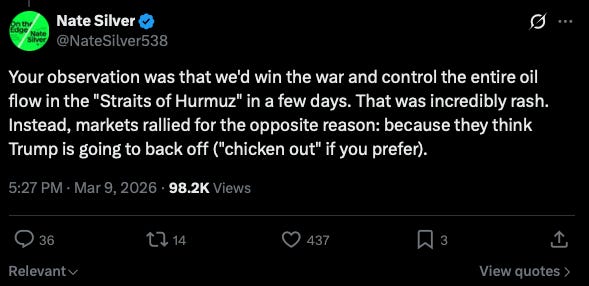
Or you can look at the HuffPost, which wrote in an article titled “Trump’s War on Iran Will End When He Declares Victory — The Only Question Is When.”
“I think there will be a ‘new normal’ in the Middle East that is not dependent on the U.S. for defense and an angry, sulking Iran that is even more hard-line and anxious for revenge. The Gulf states will arm themselves to the teeth,” said Jim Townsend, who has worked at both the Pentagon and NATO and is now an analyst with the Center for a New American Security, a center-left think tank. “The oil trade will resume, but not quickly. Too much uncertainty about Iran taking potshots at tankers or laying mines.”
Take as another example JPMorgan’s former chief strategist, who tweeted the following.
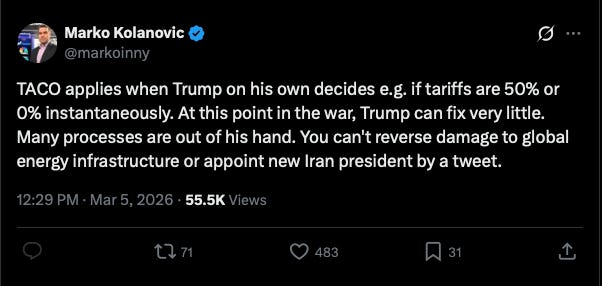
It isn’t even just liberals who feel this way. Tucker Carlson has made a point of condemning the war as fundamentally unwinnable on his podcast recently.
There are literally countless examples of this across social media, so I will not belabor the point. But it isn’t just “normies” talking this way.
Senator Mark Kelly, while speaking with reporters on Monday, March 9th, said, “Clearly, they do not have a strategic goal. They didn’t have a plan, they have no timeline. Because of that, they have no exit strategy.”
And Senate Minority Leader Chuck Schumer echoed this while chiding his Republican colleagues for going along with the war: “The American people have been clear: they do not want another endless and costly war in the Middle East. Yet today, most Senate Republicans made their choice — they sided with President Trump’s Iran War.”
So what is the basis for this belief that the war has been, and will be, a strategic catastrophe? I would largely lump them into four core arguments.
There doesn’t seem to be a path to regime change with strikes alone.
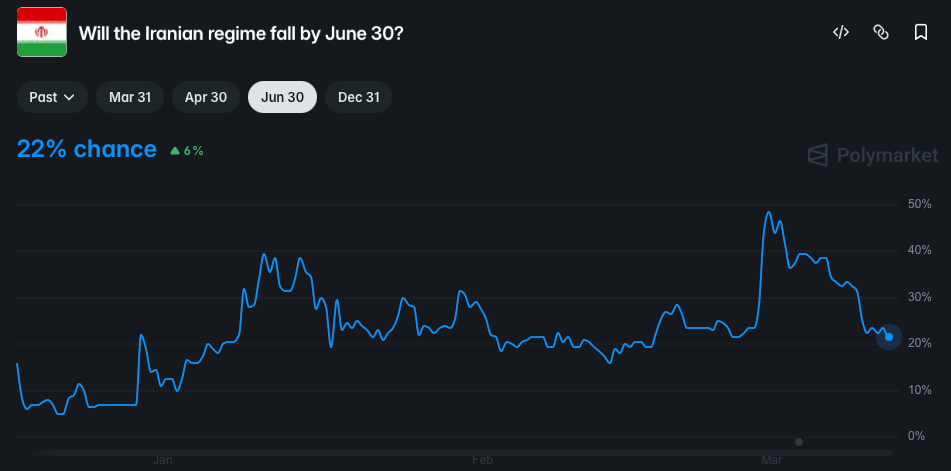
Before Operation Epic Fury began, the National Intelligence Council completed a classified assessment concluding that neither limited airstrikes nor a prolonged military air campaign would likely result in regime change in Iran, even if the current leadership was killed. So far the prediction has held, and despite Khamenei’s death on Day 1 his son, Mojtaba Khamenei, has been appointed as the new Supreme Leader, and ACLED’s March 2026 special issue found “little evidence” of internal fracture, defections, or popular uprising.
Polymarket largely agrees with this, only pricing in roughly a ¼ chance of regime collapse.
There are, to the best of my knowledge, no good examples of military strikes alone toppling a regime, but please correct me if I’m missing something.
Iranian weapons are cheap, American weapons are expensive.
The US has already burned through over 400 Tomahawk cruise missiles, over four times the annual production rate of roughly 72–100 per year. On the other side, Iran had prior to the war the ability to construct thousands of drones and missiles, such as the Shahed-136, which costs only $20,000–$35,000 each, and have been launching these at US allies and positions. Although we have thus far managed to mostly shoot them down, each interdiction is extremely expensive. A Patriot missile costs roughly $4 million, for example, and the standard practice is to launch two in order to decrease the odds of missing. This would imply a cost ratio of 100:1 in Iran’s favor, which would be completely unsustainable.
Defence Security Asia calculated that sustained Iranian barrage operations could cost the US $50–100 billion annually in interceptor expenditure alone, three to five times the entire US missile defense budget. Foreign Policy called this “The Drone Attrition Trap,” where even if the initial days of fighting have resulted in significant Iranian losses we cannot shoot down their attacks indefinitely. Unless we have actually managed to degrade their offensive capabilities to the degree the Trump administration is claiming, the US is primed to lose an attritional war with the Iranians. To compound the asymmetric cost profile, recent reports about the Iranians using small boats to mine the strait further put strain on American forces because even a single mine can functionally block the ability of tankers to safely cross.
We cannot afford to be shut down.
Since approximately 20% of global oil supply transits the Strait of Hormuz and traffic is down 90%, the US either needs to deescalate quickly or it will face a catastrophic oil shock. Brent crude spiked from roughly $70 to $119 per barrel this weekend and although it has since come down slightly, prices remain extremely elevated. Even if we do deescalate, production has already been cut by many Gulf nations. For example, Saudi Arabia’s largest refinery was targeted by a drone and is currently shut down. This is in addition to cuts at oil fields in Saudi Arabia, Iraq, and Kuwait.
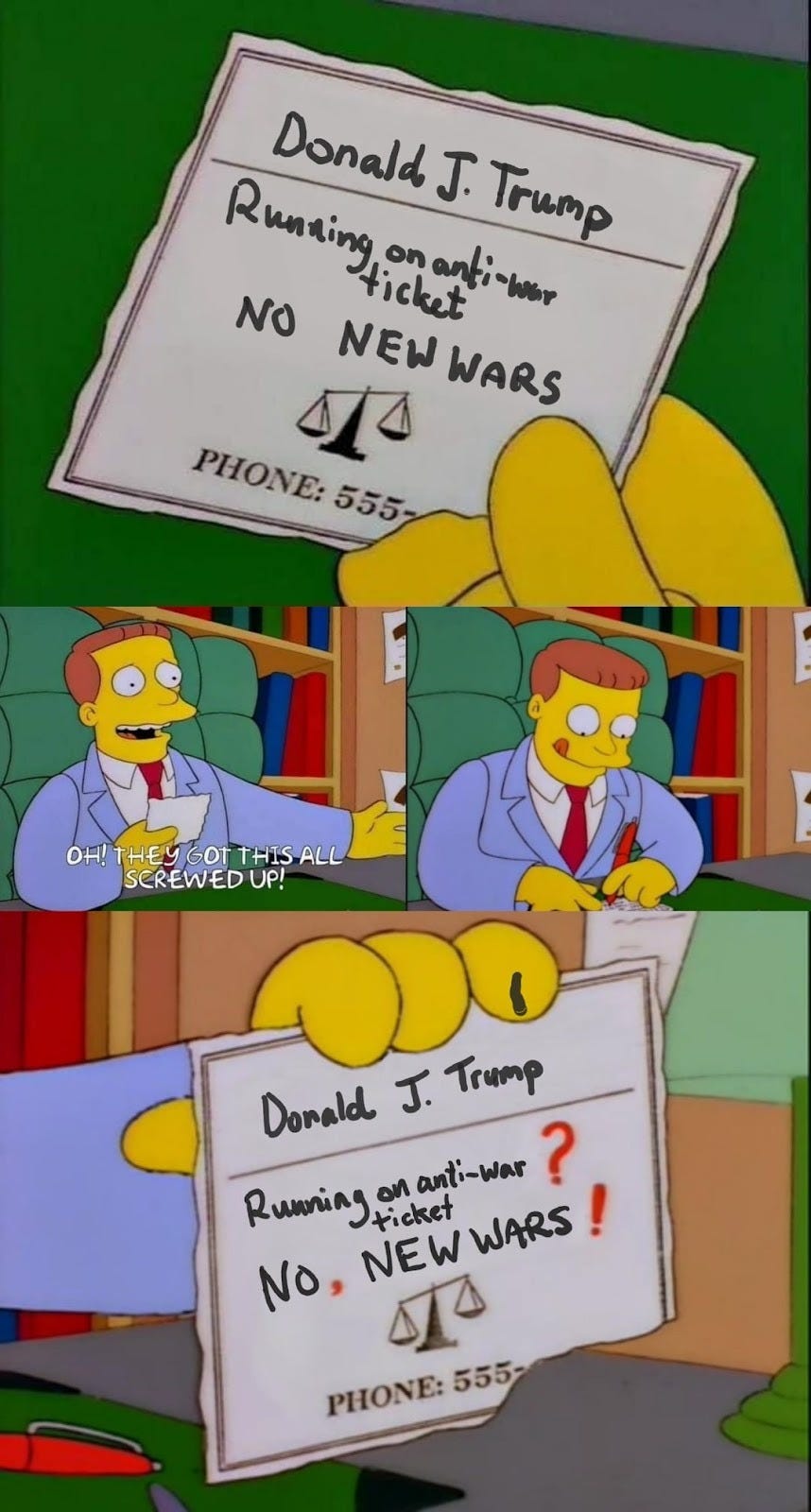
Aramco’s own CEO has warned of a “catastrophic” situation in the global economy if the strait remains closed. The war is already broadly unpopular in America, as Nate Silver pointed out, and there appears to be little appetite in the US to pay a high economic cost for another regime-change war in the Middle East. Trump pretty clearly ran in 2024 on avoiding long protracted engagements, and his administration made functionally no effort to win over the public before letting loose the dogs of war. Even if we can win, it is quite plausible there is simply no political will to win.
We have torched our global standing for what?
We cannot know exactly what is going on behind closed doors, and I would suspect most of the things I’ve read about leaks will not bear out as true. Still, it isn’t difficult to think about how this war might cost the US diplomatically, even if we militarily succeed. The American empire has largely operated through a “rules-based” international order that we created in the aftermath of WW2, and this war is, more than probably any other war in recent memory, firmly outside of it.
Not only that, but how exactly it is in the interest of America to risk the global economy and our entire empire in the hopes of totally preventing Tel Aviv from being nuked is a genuine question that is worth asking.
Even just looking at the Gulf states, it is extremely plausible to believe that even if they are currently operationally aligned with the US, this war still represents a firm breaking point in their alignment with our long-term interests. PBS reported that Gulf allies were “disappointed” the US didn’t notify them and “ignored their warnings.” Prince Turki al-Faisal, former Saudi intelligence chief, called it “Netanyahu’s war,” and as Carnegie described it, the Gulf states are “caught between Iran’s desperation and the U.S.’s recklessness.”
Our dynamic with these oil-rich nations is in many ways the lynchpin of Trump’s Middle Eastern policy, so losing them would be an unmitigated disaster. If they have decided the US is no longer a credible protector of their interests, this would amount to a fundamental global power rebalancing to the detriment of America.
Even if the Trump administration gets all of their goals and the Iranians are replaced with a compliant puppet regime that plays ball, the price to the credibility of our moral proclamations will linger for a generation. Of course, the soft realists in the Trump administration would retort by saying the credibility of our moral proclamations never mattered at all anyway, but your mileage may vary.
Where does this leave us?
I think there are coherent arguments in both narratives, and frankly we just don’t know, and cannot know, enough to say which is true right now. My gut says that the international cost will be muted enough in the short run and ambiguous enough in the long run that it will be a point of argument rather than a real hinge event. I also feel like the tactical situation for Iran is genuinely catastrophic and the war has been a clear display, even more so than Venezuela, of the overwhelming dominance of the US military. Iran was not a “weak” country — it was one of the most powerful militaries on the planet — according to GFP’s annual rankings, #16.

So the fact the US was able to delete it at an extremely low cost will be recognized by world leaders even if the general public mostly ignores it. The casualty rates in this war are approaching late Victorian wars against tribesmen ratios.
Still, I have low confidence in the strategic brilliance of the Trump administration, and even if they are not operating blindly, as many people seem to think, I do think they are underestimating the international cost of this war. America is now unapologetically a gloves-off imperium, and this means we cannot maintain it with anything but sheer force. The dream of a 1990s world where everyone peacefully arrives at the Washington liberal consensus is very much dead, and what ideology wins the future will be decided, one way or another, by blood and iron.
For my paid subscribers only. What I predict will happen: