
Real Tedmaxxing is Funmaxxing
"The Industrial Revolution and its consequences have been [fine, probably] for the human race."

In September of 1995, some two years before I was born, Ted Kaczynski, more famously known as the Unabomber, had his manifesto published in both the Washington Post and New York Times after a series of deadly bombings. The newspapers had been advised by the FBI to publish the document, which had been sent to them about two months earlier, in hopes they could use it to identify and apprehend the terrorist. Their plan worked, and Kaczynski’s brother recognized the writing style and reported him.
In the three odd decades since this happened, the Unabomber’s manifesto has existed in a somewhat liminal space in American culture. If you exist in adjacently edgy spaces, it isn’t uncommon to hear people referencing it or saying things like “Uncle Ted,” and I think this is largely for two reasons. First, unlike most other terrorists’ manifestos, Industrial Society and Its Future can easily be read right now, since it continues to be hosted by the Washington Post here. Second, it is actually a genuinely profound reflection on modernity which, in my opinion, cannot be easily shoved aside.
In this essay I’m going to take Kaczynski’s diagnosis seriously and point out where I think he missed the mark, because I fundamentally disagree with him that the gradual sublimation of humans into a broader social machine is either a) bad or b) resistible.
The core of his argument is that humans have a core psychological need for meaningful goals and autonomy, and that when we lose the ability to pursue meaningful objectives we develop pathologies much as we would if any of our psychological needs were unmet. Kaczynski claims that modern industrial society has systematically broken our ability to exercise “the power process” by reducing the effort required to meet basic survival needs to functionally zero in the developed world. In addition to this, the regimentation of our bourgeois life is such that we functionally give up all true autonomy and are forced to then develop surrogate activities, which are fundamentally unfulfilling, like video games or sports, to satisfy this need for goal accomplishment.
My thesis on the other hand is that human beings are problem-solving machines in the deep biological sense that our reward systems, our experience of meaning, and our psychological health are organized around allowing us to win the game-theoretic dance of Darwinian evolution. I would go so far as to argue that civilization’s central project, from agriculture through medicine through artificial intelligence, has been the progressive elimination of problems. Since problems are definitionally bad, their elimination is unambiguously good on its own terms. But the cumulative effect has been the systematic removal of the conditions under which human beings experience felt meaning. We are building a world that is objectively better and subjectively emptier, and we have been doing so for tens of thousands of years.
This process is irreversible for two reasons. The first is that knowledge is irreversible. You cannot unknow that a better option exists, and you cannot derive genuine meaning from a challenge you know to be artificial. The second is that competitive dynamics between groups make unilateral withdrawal suicidal. Any group that voluntarily pauses its optimization will be outcompeted and destroyed by groups that do not.
But where I would differ from most people who agree with me on everything above is that I don’t take for granted the belief that this process is “bad.” The belief in its fundamental bleakness depends on an assumption that deserves scrutiny: specifically that the individual human, with its current set of drives and its current experience of meaning, is the relevant unit of analysis in perpetuity.
Because it seems more likely that what we are undergoing is another transformation in the long history of biology and that we as humans are no more doomed to misery than our neurons or mitochondria are. This belief is AI-agnostic because I don’t think the process of sublimation depends on some future AI singularity. Objects like nations and companies are already taking on many of the characteristics of distinct Darwinian entities in a very real sense.
Every major transition in the history of biology has followed the same basic pattern. Independent replicating units begin cooperating, which leads to interdependence and specialization until they totally lose their individual autonomy and merge into a higher-order entity that then becomes a new unit of selection.
We are in the middle of such a transition. The specifics of the endpoint are uncertain right now, but I don’t think the direction is ambiguous at all; we are on this ride no matter what. But it isn’t even like we are being dragged into this transition against our nature. There are large, real, and important parts of us that already love social belonging and derive substantial meaning from it. That experience of genuine satisfaction from being useful components of something larger than ourselves is not a weakness to be lamented but almost certainly what strength actually looks like in modernity.
As a person, what does this mean? Well, probably very little, but it does imply that there are few downsides to simply doing what you love. I’ll put myself in this category. What I love more than anything in the world is writing. Perhaps this is a genuine surrogate activity, I don’t know, but I’ve decided to genuinely try to do this for my career because anything else would be misery. You have no choice but to do what you want with your life, because what could the alternative possibly be?
That is the whole argument. The rest of this essay is the evidence.
The Power Process
The most important sections of Kaczynski’s manifesto, Industrial Society and Its Future, are paragraphs 33 through 67, which contain, in my opinion, one of the clearest descriptions of the relationship between effort, autonomy, and psychological health written in the twentieth century. As I’ll get into later, he isn’t the only person to make these observations, but at least from what I’ve read he is alone in his willingness to be ruthlessly honest about reality.
So what is the power process? To quote him directly:
“Human beings have a need (probably based in biology) for something that we will call the ‘power process.’ This is closely related to the need for power (which is widely recognized) but is not quite the same thing. The power process has four elements. The three most clear-cut of these we call goal, effort, and attainment of goal. (Everyone needs to have goals whose attainment requires effort, and needs to succeed in attaining at least some of his goals.) The fourth element is more difficult to define and may not be necessary for everyone. We call it autonomy and will discuss it later.”
It is worth noting that Kaczynski concedes here that autonomy is not necessary for everyone and that some people genuinely find satisfaction through identification with a larger organization. Kaczynski basically ignores this thread because it cuts against the rest of his writing substantially, in my opinion.
Still, the key insight is that not only do people need goals, but those goals must be substantively real. Goals that we create to fill the emotional need for the power process are “surrogate activities,” defined as follows:
“We use the term ‘surrogate activity’ to designate an activity that is directed toward an artificial goal that people set up for themselves merely in order to have some goal to work toward, or let us say, merely for the sake of the ‘fulfillment’ that they get from pursuing the goal. Here is a rule of thumb for the identification of surrogate activities. Given a person who devotes much time and energy to the pursuit of goal X, ask yourself this: If he had to devote most of his time and energy to satisfying his biological needs, and if that effort required him to use his physical and mental faculties in a varied and interesting way, would he feel seriously deprived because he did not attain goal X? If the answer is no, then the person’s pursuit of goal X is a surrogate activity. Hirohito’s studies in marine biology clearly constituted a surrogate activity, since it is pretty certain that if Hirohito had had to spend his time working at interesting non-scientific tasks in order to obtain the necessities of life, he would not have felt deprived because he didn’t know all about the anatomy and life-cycles of marine animals. On the other hand, the pursuit of sex and love (for example) is not a surrogate activity, because most people, even if their existence were otherwise satisfactory, would feel deprived if they passed their lives without ever having a relationship with a member of the opposite sex. (But pursuit of an excessive amount of sex, more than one really needs, can be a surrogate activity.)”
By this criterion, I think it would be fair to say that most of what educated moderns such as myself do with their free time qualifies as a surrogate activity. Of course he would argue that they are fundamentally unsatisfying. Specifically:
“For many if not most people, surrogate activities are less satisfying than the pursuit of real goals (that is, goals that people would want to attain even if their need for the power process were already fulfilled). One indication of this is the fact that, in many or most cases, people who are deeply involved in surrogate activities are never satisfied, never at rest. Thus the money-maker constantly strives for more and more wealth. The scientist no sooner solves one problem than he moves on to the next. The long-distance runner drives himself to run always farther and faster. Many people who pursue surrogate activities will say that they get far more fulfillment from these activities than they do from the ‘mundane’ business of satisfying their biological needs, but that is because in our society the effort needed to satisfy the biological needs has been reduced to triviality. More importantly, in our society people do not satisfy their biological needs AUTONOMOUSLY but by functioning as parts of an immense social machine. In contrast, people generally have a great deal of autonomy in pursuing their surrogate activities.”
It is this autonomy point that is truly the sticking point in his argument. Because clearly humans have to engage in complex and meaningful work for our own survival; it just occurs at the large collective level as part of the capitalist machine of production and distribution rather than at the small-group level. Now I think the most important line of the entire manifesto is paragraph 178.
“Whatever else may be the case, it is certain that technology is creating for human beings a new physical and social environment radically different from the spectrum of environments to which natural selection has adapted the human race physically and psychologically. If man is not adjusted to this new environment by being artificially re-engineered, then he will be adapted to it through a long and painful process of natural selection. The former is far more likely than the latter.”
Because I think that it is exactly correct, but I do not see it as immediately and obviously “evil.” Clearly our conditions today are unique, and I agree eventually we will be fit to them one way or another.
Now I mentioned that Kaczynski was not writing in isolation, and given the nature of how I came to know about his work I don’t want to leave out the larger, more civilized academic discussion.
Consider Viktor Frankl’s work, in particular his famous book titled Man’s Search for Meaning about his time in the concentration camps. The core observation he makes is that humans can endure almost any suffering if it has meaning; the moment meaning is absent though they collapse psychologically. The second half of the book is mostly about his method — logotherapy — which is designed to help patients find said meaning. Now this is where I think he is weaker than Kaczynski, because I think any attempt to “create” meaning inevitably becomes a surrogate activity. The conditions for genuine meaning have to come from an alignment of our desires and the external world; no amount of therapy can do that.
Next there is Mihaly Csikszentmihalyi and his research on flow states. In short, he argues that flow states exist in a balance between the challenge at hand and the skill of the person facing it, very similar to one of Kaczynski’s requirements for the power process.
Csikszentmihalyi wrote: “The best moments in our lives are not the passive, receptive, relaxing times.” They are moments when “a person’s body or mind is stretched to its limits in a voluntary effort to accomplish something difficult and worthwhile.” But I would argue that Csikszentmihalyi does not follow this logic to its obvious conclusion. If flow requires real challenge matched to real skill, and if civilization is in the business of eliminating real challenges, then civilization is in the business of eliminating the preconditions for “the best moments in our lives.”
Finally, consider Edward Deci and Richard Ryan’s Self-Determination Theory (SDT), which identifies three basic psychological needs: autonomy, competence, and relatedness. The first two map directly onto Kaczynski’s power process, with the addition of relatedness as well. SDT is an extraordinarily well-validated theory empirically, with thousands of studies supporting it across nearly every culture and context.
I think the third need that SDT identifies — relatedness, or the need for belonging and connection to others — is extremely important because it is evidence that we are already learning to love our status as part of the social organism. Still, similar to Csikszentmihalyi, few people who engage with SDT seriously seem to realize the implications their theory shows about what it means to be a human in modernity.
Now I’ll give a somewhat silly example of the power process in action and how losing it can permanently change my enjoyment of an activity.
GameStop
When I was a kid, the best way to get a game was to go to GameStop and browse their selection of used games. What this meant was I needed to go to my parents and ask them for a ride to the store, and then look through their collection of games, most of which I had never heard of, and decide which one I would buy. I was operating under limited information, of course, because my phone didn’t have easy access to Metacritic, and I would have to go off of signals like the box art or description. In a way, the whole activity became a quest where the prize I was searching for was a fun game. I genuinely wanted to play a good game, and so it wasn’t like the intermediate steps were false constructions; they were, in fact, the optimal way of achieving that objective given my constraints.
But in 2026 the world has been totally transformed. Now with Game Pass I have instant access to hundreds of games, and through my phone I can immediately search for nearly limitless analysis for any game in existence. Clearly Game Pass is superior to going to GameStop by every possible measure. Not only that, but GameStop literally still exists, and nothing is stopping me from just going there right now and sticking to the old way of doing things. So clearly, via revealed preferences, I genuinely do prefer a world with instant access to games. But still.
Something was destroyed in the optimization, and the quest that used to exist is just gone now. The anticipation, the deliberation, the weight of an irreversible choice made under uncertainty — all the things that made getting a new game feel like it meant something — have been eliminated precisely because they are inefficiencies. Optimization did exactly what it was supposed to do and removed the obstacles between myself and the best possible game, but in doing so it removed a huge part of the experience for me as well.
I would argue it is this mechanism behind the Easterlin paradox, which shows that at any given moment, more money buys more happiness, but over time, more money for everyone buys no additional happiness for anyone.
I don’t think the resolution is complicated, even if it is potentially a little grim. What people experience as happiness from wealth is not so much a response to absolute material conditions as it is to their position relative to expectations about where their absolute material conditions “should” be. Thus, when everyone gets richer, expectations rise in lockstep, and the hedonic gain is consumed by the new baseline.
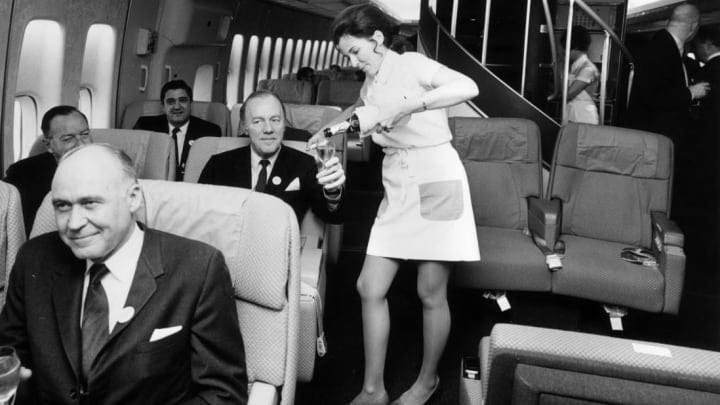
I’m not making not the first person to make this observation. Philip Brickman and Donald Campbell formalized this in 1971 as “hedonic relativism,” where they argued that people judge gains and losses not in absolute terms but relative to an adaptation level set by prior experience.
Bringing it back to GameStop, the GameStop quest was meaningful because the constraints were real and the process was the only optimal strategy for getting a good game. I wasn’t choosing to inconvenience myself at all, but now if I tried to do it again I would be. And this is irreversible, because the knowledge is irreversible. Even if tomorrow the internet shut down, I would still compare my experience at GameStop against the world which I have right now.
The principle operates at every scale. Spotify is better than building a music collection, but to a lot of people their collections used to mean something. Or using a GPS is better than reading a map, but navigating used to be a skill that conferred competence and autonomy. In each case, the optimization is individually rational, universally adopted, and quietly corrosive to the felt experience it was meant to improve. And no one can opt out, because opting out of one optimization while everyone else opts in just makes you worse off without restoring the meaning.
You Cannot Opt Out
The easy answer to all of this would be the construction of intentional communities where people can control their experiences and retain some optimal amount of autonomy and struggle, but I would argue that someone can only opt out of optimization if someone else is still optimizing on your behalf.
The Amish are probably the canonical example people want to point to when arguing that rejecting modernity is a viable path, because the Amish do, in fact, live in a way that preserves many of the conditions Kaczynski identified as necessary for the power process. But the Amish exist inside the United States of America, and their farms are protected by our nuclear weapons.
They do not defend their borders or negotiate trade agreements. Instead, their opt-out is subsidized entirely by the civilization they see as corrosive, which is the opposite of self-sufficiency.
To consider what happens when a group opts out without a protector, you only need to look at China in the 18th and 19th centuries. Its weakness was not respected by the European nations, because why would it be? The idea that you can simply refuse to participate in the optimization race and be left alone to live your authentic life is just naive. Virtuous weakness buys you nothing but sympathy or subjugation by the strong.
Scott Alexander has an incredible essay called “Meditations On Moloch” where he describes the “multipolar trap,” where, in any competitive system with multiple agents, each agent is incentivized to optimize along whatever dimension determines survival, even if the aggregate effect of everyone optimizing is worse for everyone.
Climbing the Problem-Solving Tree
The entire arc of human history is progressive problem elimination and progressive sublimation to the group. Every advance exists literally to address some problem and, in turn, constrains us in some important way.
Agriculture, for example, solved the problems created by increasing population density by allowing us to eke more calories out of the same plot of land, but it also substantially tied us to the land, and the surplus freed people to specialize and so develop interdependence. It also created the first class of people with nothing “real” to do in the early priests, aristocrats, and bureaucrats, which resulted in the first surrogate activities such as philosophy.
Or the Industrial Revolution, which solved the problem of “labor” by replacing animal or human labor with other forms of energy. This created an explosion in our ability to produce the material necessities of life, but it also regimented our lives and further specialized our labor.
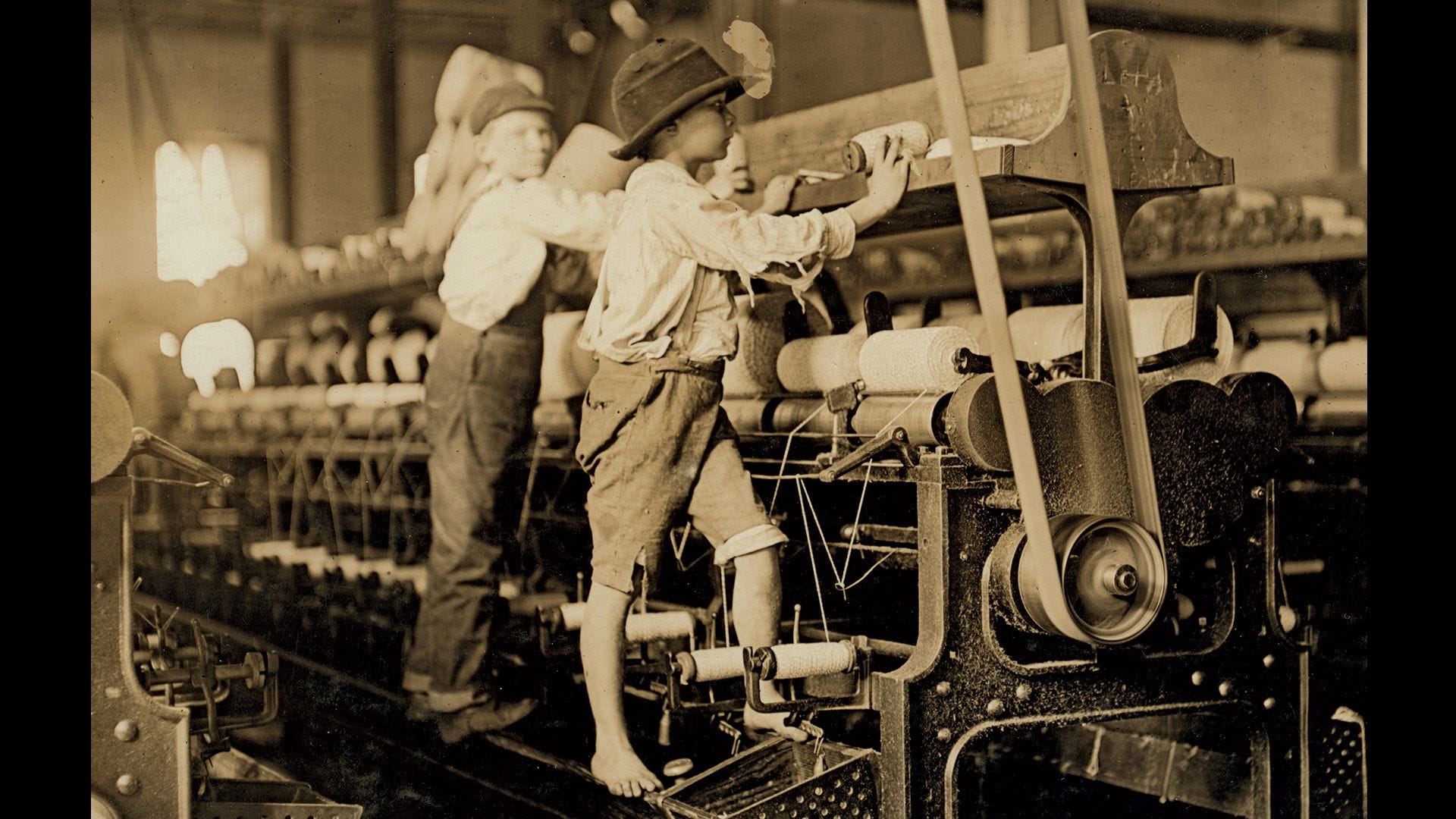
Each of these transitions follows the same basic pattern. A real problem that gave effort its meaning is solved, the solution is adopted universally because it is genuinely superior, and the domain of real problems a person can autonomously solve shrinks. In turn, the domain of surrogate activities expands to fill the gap, and humans lose another bastion of meaning.
If the pattern is progressive problem elimination, and if each elimination removes a domain where human effort was meaningful, then the trajectory, taken to its logical endpoint, is the elimination of human problem-solving itself.
Whether AI specifically is the technology that completes this trajectory, or whether some other system is the god at the end of time, doesn’t really matter. What is important is the basic historical trajectory. Since it depends on the competitive dynamics described in the previous section, the endpoint is the same either way: human beings cease to be the locus of problem-solving. We become, in the most literal sense, unnecessary to the system’s continued operation.
This is where most people stop and declare the situation hopeless, or deny the trajectory, or retreat into some version of “it won’t happen in my lifetime.” All three responses are understandable. But I don’t think any of them are honest.
John Maynard Smith and Eörs Szathmáry’s “The Major Transitions in Evolution” makes an argument that I believe reframes the problem substantially. Their claim is that the history of life is not a smooth gradient of increasing complexity but instead is punctuated by a series of rare, discrete transitions in which previously independent biological units lose their autonomy and become interdependent before merging into a higher-order entity that then becomes the new unit of selection.
Robert Wright, in Nonzero, arrives at a complementary conclusion from a different direction. Wright argues that the arc of both biological and cultural evolution is driven by the increasing realization of non-zero-sum interactions — situations where cooperation produces gains that competition cannot. Specifically, he argues that natural selection does not merely favor the strong over the weak in a zero-sum contest, but instead tends also to favor organisms, and later societies, that discover ways to cooperate, specialize, and coordinate. Since groups that cooperate outperform groups that do not, and outperformance is what matters, there is a relentless push against our individual incentives to defect and instead cooperate.
In other words, this next stage is not some tragic end of historical development so much as another step in a process of which we are currently the knife point.
A coherent counterargument to everything I’ve said thus far comes from Friedrich Nietzsche, whose entire philosophical project was, in a sense, a war against exactly this trajectory. In “On the Genealogy of Morals”, Nietzsche traces the origin of moral values to a conflict between two types: the aristocratic, who define “good” spontaneously out of their own strength and vitality, and the slavish, who define “good” reactively as the opposite of whatever the strong do. In short, aristocratic morality says yes to life, whereas slave morality says no to everything that threatens the weak.
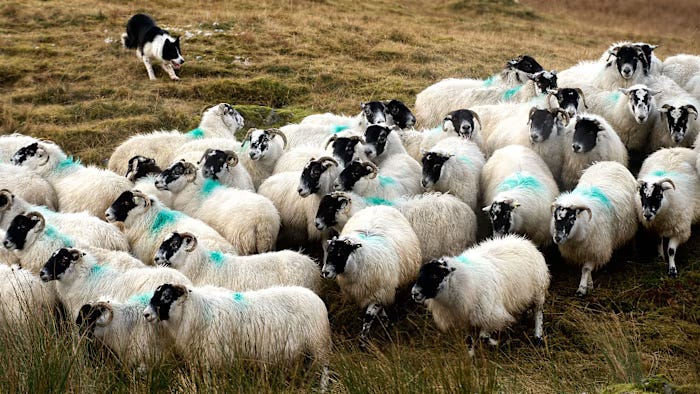
Nietzsche’s famous parable of the lambs and the birds of prey in On the Genealogy of Morals, Essay I, Section 13, is the clearest expression of this theory:
“That lambs are annoyed at the great predatory birds is not a strange thing, and it provides no reason for holding anything against these large birds of prey, because they snatch away small lambs. And if the lambs say among themselves, ‘These predatory birds are evil — and whoever is least like a predatory bird — and especially who is like its opposite, a lamb — shouldn’t that animal be good?’ there is nothing to find fault with in this setting up of an ideal, except for the fact that the birds of prey might look down with a little mockery and perhaps say to themselves, ‘We are not at all annoyed with these good lambs — we even love them. Nothing is tastier than a tender lamb.”
Nietzsche’s metapoint can broadly be characterized as the belief that the lambs’ declaration of evil was life-denying and degenerative. In Beyond Good and Evil, he describes this same herd instinct as the dominant force in European civilization, one that has made obedience innate and turned the art of command into a guilty secret. This suppression of the exceptional individual was, if you read his works honestly, obviously seen as a disaster that needed to be battled.
Here is my response, and I want to be precise about it because Nietzsche is not an opponent to be dismissed cheaply.
Nietzsche’s own framework defeats his worship of the aristocratic. If you accept his basic distinction between “good and bad” (what makes you stronger or weaker) and “good and evil” (based on resentment and moral condemnation), then you have to ask why the herd is continually winning.
And if your framework says that an ideology built on resentment is degeneration, then how is resentment toward the lambs for imposing order any different? If the lambs organized, developed weapons, built institutions, domesticated the landscape, and systematically selected against every eagle born for ten thousand years — as humans have done — then by the very logic Nietzsche celebrated, the lambs are the superior organism. Not morally superior in the Christian sense, which Nietzsche rejected, but superior in the only sense he claimed to recognize.
Nietzsche did see this, of course, and his argument was ultimately that the lambs won through ressentiment and through the falsification of values rather than genuine strength. But why does this matter? If this is how the herd prevails, then that is the tool they use, and it is just as amoral as the eagle’s talons.
Here is where the future turns from black to maybe a light gray for me. Because both Nietzsche and Kaczynski saw that the individual was being absorbed as fundamentally a degenerate process that dragged us down to some lower, baser state. Both men assumed that what was being lost — individual autonomy, sovereign agency, the power process — was the highest expression of the universe and that nothing of value was truly being gained. But I just disagree.
Not only because what we are building — human civilization — is fucking incredible, but also because we clearly derive a huge amount of satisfaction from participation in the greater system.
Look at Self-Determination Theory’s third need: relatedness. Clearly the need for belonging and being part of something larger is just as real as any other innate human drive, with the same empirical standing as autonomy and competence. Because of course it is. Since the level of selection is not only the individual but also the group — as I’ve been arguing — we would naturally come to love, over time, the things that make us strong.
What Nietzsche saw as slave morality imposing itself on people and turning their desire for power inward can equally be seen as us increasingly developing an instinct which places the outcome of the whole group as important to us, not merely ourselves. This is evidence that the transition to a higher-order organism is already underway and that it already feels good and necessary from the inside.
To understand this better, it is worth explaining how this works mechanistically.
Multi-Level Selection
The claim that modern humans are a bundle of contradictory drives pulling us in pro- and antisocial directions is, in my opinion, pretty well vindicated by experience. Clearly humans care about things like their family or their community, and clearly humans also engage in activity that harms people they “should” care about in the name of selfishness.
But why? Why is it that on one hand there is an intrinsic desire to self-maximize and also a desire to sublimate into the group?
I think the answer lies in biology. To understand this it is worth understanding how traits become more widespread in a population, and the starting point is George Price’s covariance equation.
The Price equation describes the change in any trait across a generation as a function of the covariance between that trait and fitness. If that trait is positively correlated with reproductive success, then that trait will become more common. Notably, the equation is agnostic about the mechanism through which the trait and fitness are related, meaning this could apply to genetics as well as culture.
Additionally, the relationship can be decomposed, allowing you to partition the total change in a trait into components attributable to selection at different levels — within groups, between groups, and at any other level you can define.
David Sloan Wilson, drawing on Price’s framework, has argued that the debate over altruism in evolutionary biology resolves cleanly once you accept that selection operates at multiple levels simultaneously. Basically, within any group, selfish individuals outcompete altruistic ones, meaning that, on average, fitness will be positively correlated with selfishness.
But since groups also compete against other groups, the equilibrium cannot simply default to pure defection. If the ratio of antisocial behavior gets too high within a group, that group will simply be outcompeted by groups that are able to maintain internal discipline.
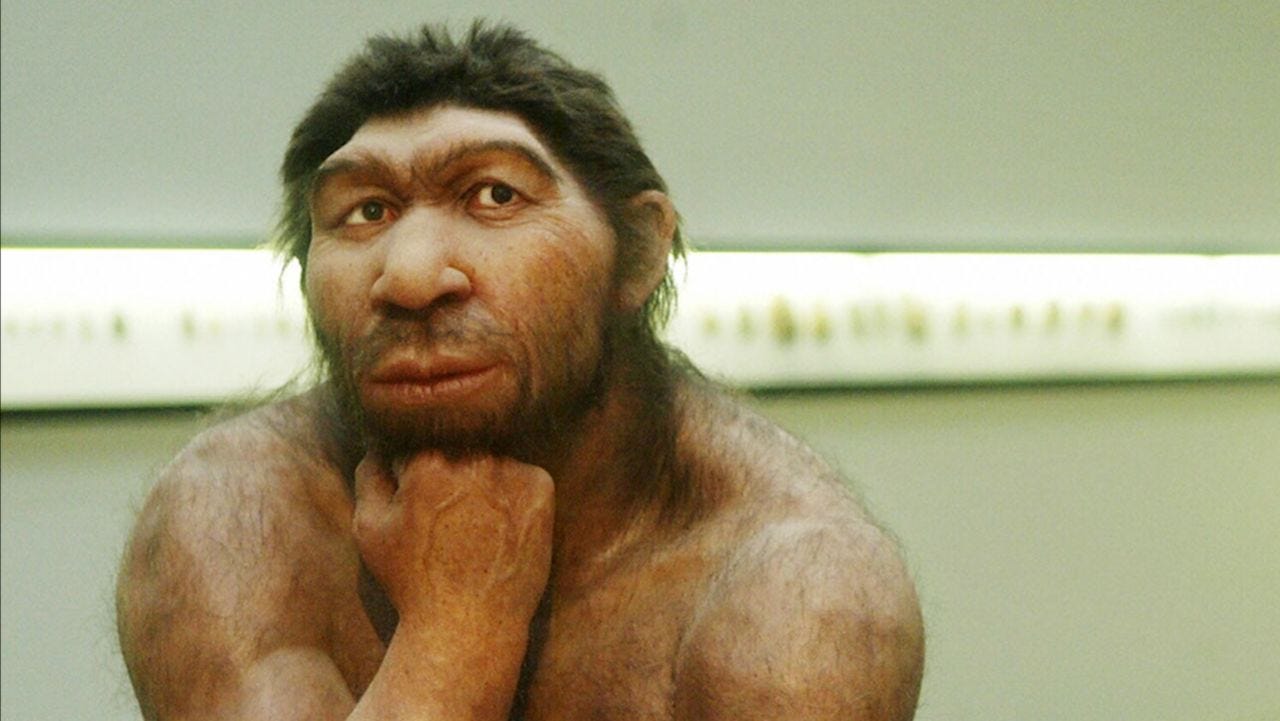
It can be controversial to debate the extent of direct genetic, as opposed to cultural, group replacement that has occurred among modern humans. But it is undeniable that if you zoom out and look at the four-odd million years of hominid evolution, selection has repeatedly occurred at the species level. No one can ask the Neanderthals if they think groups of a dozen people is too much group sublimation.
The argument above can be stated formally in a simple model of a public goods game with between-group competition. If you want a formal toy model you can look here1 but what matters is that the equilibrium frequency of cooperation increases as it becomes more selectively useful.
But since the forces of individual and group selection are in tension the result is a stable polymorphism: a population containing both cooperators and defectors or, I think realistically to the human condition, individuals whose propensity to cooperate is some intermediate value from a distribution of possible types, the balance of which is maintained by the opposing pressures of two levels of selection.
“Do I contradict myself?
Very well then I contradict myself,
(I am large, I contain multitudes.)”
So as the benefit-to-cost ratio increases and the cost of intergroup competition increases, so too does the equilibrium level of cooperation.
Because of the scale evolutionary history is operating under, I’m only tangentially talking about modern events such as the conquest of the Americas — which definitely can be understood on a group-selection level — but about the entire scope of our evolutionary history, which is littered with the carcasses of dead species.
In the moment we are in, there is still real tension, and we are torn between these instincts. But just like the previous steps up the evolutionary ladder, there is no a priori reason to think this is headed toward some universal cliff.
Instead, as the gains to cooperation continue to increase and the cost of not cooperating similarly climbs, humans will follow the gradient descent, and we — or whatever comes next — will find more and more meaning in coordination and less and less pleasure in autonomy.
What does this imply?
Let me state the conclusion without blinking or shying away.
Every prior major transition in the history of life eliminated the autonomy of the lower-level unit, and in no case did that unit’s preferences about the matter turn out to be relevant. The prokaryote did not vote on becoming a mitochondrion. The single-celled organism did not consent to multicellularity. In each case, the entities that resisted integration were not rewarded for their independence — they were outcompeted and destroyed by the entities that cooperated. What survived was the higher-order whole, and the components that had once been autonomous became so thoroughly integrated that the question of their “freedom” ceased to be meaningful.
We are in the middle of exactly this kind of transition, and the concept of “bad” that both Kaczynski and Nietzsche rely on is itself a product of individual-level selection pressures. It is not some objective truth about the universe. It is a drive that exists because it used to be adaptive for organisms like us to resist absorption — back when the relevant unit of selection really was the individual or the small group. The feeling that this transition is a tragedy is not a clear-eyed assessment of reality. It is the last expression of a selection pressure that is actively losing. The sense that something precious is being destroyed is real, in the way that all feelings are real, but it is not evidence that something precious is actually being destroyed in any frame larger than our own transient one.
Recently I was at dinner with DeepLeftAnalysis🔸 and I was complaining about some grocery store nonsense — specifically that an Italian market versus some halal international store in California. He made the point to me, iirc, that maybe my great-grandparents would have hated the Italian place.
I couldn’t stop thinking about this, because it captures the way life actually works pretty well. The Italian market was at one point change and disruption and full of food the people around it didn’t eat. And then a new generation grew up with it, their tastes shifted, and it became a thing that they loved. The halal market is exactly the same. To me it is different, and that is frustrating, but to my hypothetical grandchildren it will just be part of the texture of life.
Every generation experiences the most recent round of integration as loss and the previous rounds as natural.
Now — the obvious objection. Isn’t this just saying that anything that happens is good because adaptation will smooth it over? My response is no, because I am not making any moral claims at all. I’m claiming that things which are selectively good persist, and that people grow to love that which is selectively good. I would argue there is no independent third person view that can adjudicate if the transition is good or bad normatively in any frame-independent sense.
For my paid subscribers only. What the hell should you even do?
I have just spent some eight thousand odd words arguing that individual agency is being absorbed into a superorganism but everyone reading this, perhaps other than the future AIs, are individuals with individual lives and preferences that still are subjectively very real.
